
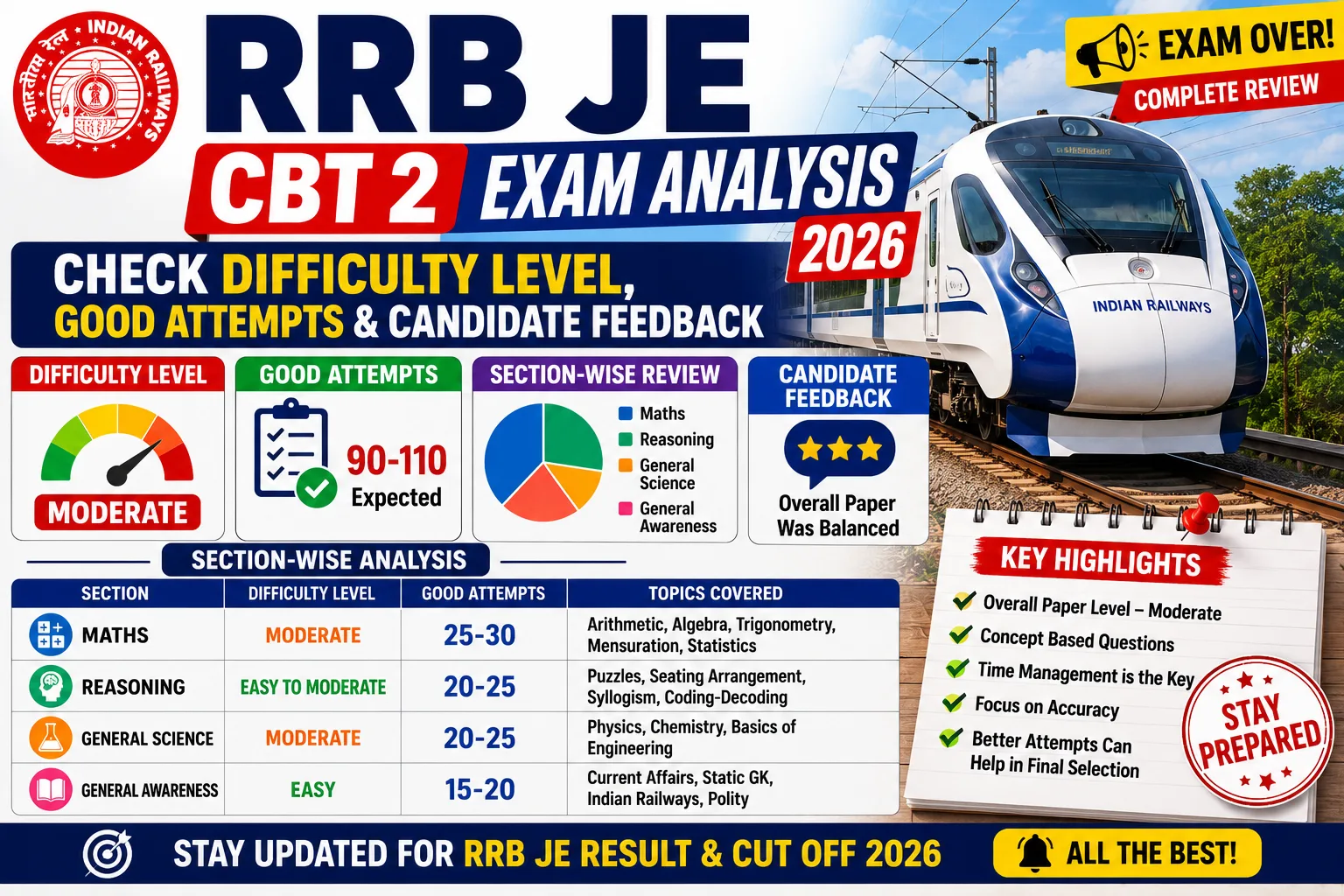
RRB JE CBT 2 Exam Analysis 2026: Difficulty Level, Good Attempts, Section-Wise Review & Candidate Feedback.The Railway Recruitment Board (RRB) successfully conducted the RRB Junior Engineer (JE) CBT 2 Exam 2026 on 2 July for candidates shortlisted after the CBT 1 stage. Thousands of engineering graduates from Civil, Mechanical, Electrical, Electronics, and other disciplines appeared for the examination, hoping to move one step closer to securing a Junior Engineer position in Indian Railways.
As soon as the examination concluded, candidates shared their first reactions about the paper. Based on their feedback, the overall exam was easy to moderate, with the Technical Abilities section emerging as the most challenging and time-consuming part of the paper. While the non-technical sections featured mostly direct questions, the technical portion required conceptual understanding and subject-specific knowledge.
If you appeared for today’s exam or are waiting for the official answer key, here’s a complete RRB JE CBT 2 Exam Analysis 2026, including the overall difficulty level, section-wise review, expected good attempts, important topics, candidate reactions, and expert opinion.
RRB JE CBT 2 Exam 2026: Overview
The CBT 2 examination is the second stage of the RRB Junior Engineer recruitment process. It assesses candidates on technical subjects along with General Awareness, Physics & Chemistry, Computer Applications, and Environment & Pollution Control.
| Particulars | Details |
|---|---|
| Exam Name | RRB Junior Engineer CBT 2 Exam 2026 |
| Conducting Body | Railway Recruitment Board (RRB) |
| Exam Date | 2 July 2026 |
| Exam Mode | Computer-Based Test (CBT) |
| Total Questions | 150 |
| Maximum Marks | 150 |
| Duration | 120 Minutes |
| Negative Marking | 1/3 Mark for Every Incorrect Answer |
| Selection Process | CBT 1, CBT 2, Document Verification & Medical Examination |
RRB JE CBT 2 Exam Pattern 2026
| Subject | Questions | Marks |
|---|---|---|
| General Awareness | 15 | 15 |
| Physics & Chemistry | 15 | 15 |
| Basics of Computer Applications | 10 | 10 |
| Environment & Pollution Control | 10 | 10 |
| Technical Abilities | 100 | 100 |
| Total | 150 | 150 |
Overall Exam Analysis 2026
Candidates described this year’s paper as balanced, with a clear emphasis on conceptual understanding instead of rote learning. The overall pattern remained similar to previous recruitment cycles, but several technical questions demanded a deeper understanding of engineering fundamentals.
The General Awareness, Computer Applications, and Environment sections were comparatively easier and allowed candidates to save time for the lengthy Technical Abilities section.
Overall Difficulty Level
| Section | Difficulty Level |
|---|---|
| General Awareness | Easy |
| Physics & Chemistry | Easy |
| Computer Applications | Easy |
| Environment & Pollution | Easy |
| Technical Abilities | Easy to Moderate |
| Overall Paper | Easy to Moderate |
Candidates with a strong command of their engineering discipline generally found the paper manageable despite the lengthy technical section.
Good Attempts
Based on the initial feedback received from candidates and subject experts, attempting 110 to 125 questions with high accuracy is expected to be a competitive score.
| Category | Expected Good Attempts |
|---|---|
| Overall | 110–125 Questions |
As the exam included negative marking, accuracy remained more important than attempting every question.
Section-Wise Exam Analysis
General Awareness
The General Awareness section consisted mainly of direct questions from current affairs and static General Knowledge. Candidates reported that this section was one of the easiest parts of the paper.
Major Topics
- Current Affairs
- Important Days
- Indian History
- Geography
- Indian Constitution
- National Events
Most candidates completed this section quickly.
Physics & Chemistry
Questions in this section focused on basic engineering-level concepts rather than advanced numerical problems.
Important Topics
- Basic Physics
- Engineering Chemistry
- Scientific Principles
- Chemical Reactions
The section was straightforward for candidates with basic technical preparation.
Computer Applications
Computer Awareness was another scoring section.
Topics Asked
- MS Excel
- MS PowerPoint
- Cyber Security
- Computer Fundamentals
- Basic Programming Concepts
Most questions were direct and required only fundamental computer knowledge.
Environment & Pollution Control
The Environment section included questions based on environmental awareness and pollution management.
Important Topics
- Waste Management
- Water Treatment
- Biodiversity
- Pollution Control
- Environmental Protection
Candidates found this section simple and less time-consuming.
Technical Abilities Analysis
The Technical Abilities section carried the highest weightage and played the biggest role in determining overall performance.
Unlike previous years, the paper emphasized conceptual understanding more than lengthy numerical calculations. Candidates from different engineering streams reported discipline-specific questions that closely matched the prescribed syllabus.
Mechanical Engineering
Important topics included:
- Manufacturing Processes
- Production Engineering
- Strength of Materials
- Fluid Mechanics
- Metrology
- Welding
- Otto Cycle
- Stress and Strain
Many candidates said conceptual questions outnumbered numerical problems.
Civil Engineering
Questions were mainly asked from:
- RCC
- Surveying
- Building Materials
- Concrete Technology
- Steel Structures
- SFD & BMD
- Construction
- Timber
- Building Drawing
The section required a clear understanding of engineering fundamentals.
Electrical Engineering
Candidates reported questions from:
- Power System
- Electrical Measurements
- Electronics
- Earthing
- Illumination
- SCR
- IC 555
- C Programming
The paper focused on practical engineering concepts rather than theoretical definitions.
Candidate Reactions
Candidates shared mixed reactions after the examination, but most agreed that the paper followed the expected pattern.
Some common observations included:
- Technical questions required conceptual clarity.
- General Awareness was relatively easy.
- Computer Applications was one of the highest-scoring sections.
- Physics & Chemistry contained mostly direct questions.
- Time management became challenging during the Technical Abilities section.
Overall, candidates who regularly practiced mock tests and revised core engineering subjects felt more confident about their performance.
Important Topics Asked
Based on candidate feedback, some of the major topics covered in today’s examination included:
- Manufacturing
- Fluid Mechanics
- Thermodynamics
- Strength of Materials
- Hydraulics
- Metrology
- RCC
- Surveying
- Concrete Technology
- Power System
- Electronics
- Cyber Security
- Environmental Pollution
- Current Affairs
- Important National Days
These topics accounted for a significant portion of the technical and non-technical sections.
Expected Cut-Off Trend
The official cut-off will be announced after the completion of the evaluation process. However, experts believe that the cut-off may remain close to previous years because of the balanced difficulty level of the examination.
Several factors will influence the final cut-off, including:
- Number of vacancies
- Overall difficulty level
- Category-wise competition
- Candidate performance
- Normalization process
Expert Opinion
This year’s paper clearly reflected a shift toward conceptual and application-based learning. Candidates who focused on understanding engineering principles instead of memorizing formulas found the examination more comfortable.
Experts recommend that future aspirants strengthen their technical fundamentals, revise previous years’ question papers, and continue solving mock tests regularly to improve both speed and accuracy.
Key Takeaways
The RRB JE CBT 2 Exam 2026 reinforced several important preparation lessons:
- Technical concepts remain the backbone of the examination.
- General Awareness continues to be a high-scoring section.
- Computer Applications can significantly improve overall marks.
- Conceptual clarity is more valuable than rote memorization.
- Time management plays a crucial role in maximizing attempts.