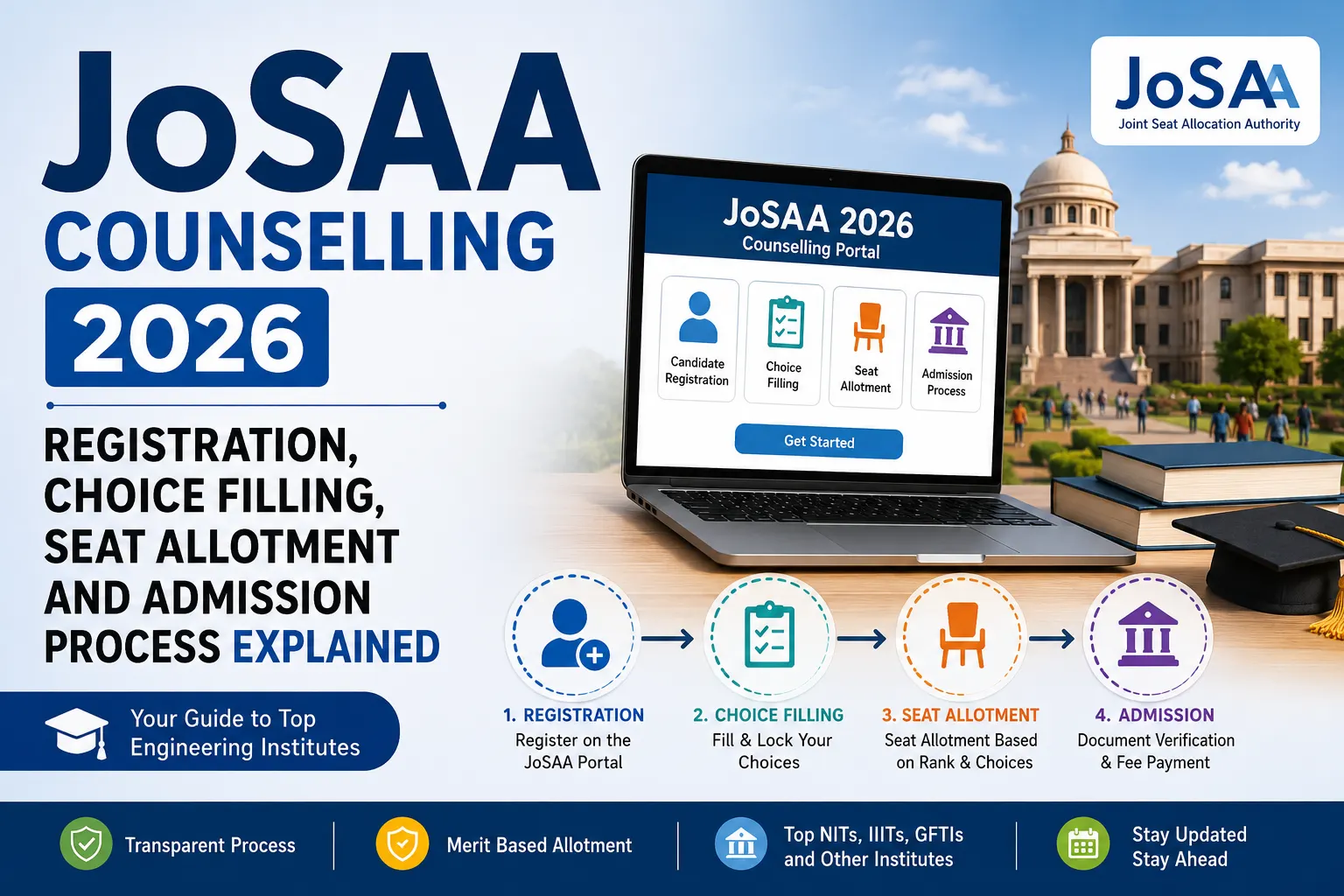
JoSAA Counselling 2026: Registration, Choice Filling, Seat Allotment and Admission Process Explained.For engineering aspirants across India, qualifying JEE Main or JEE Advanced is only the first step toward securing admission to a top college. The real journey begins with the counselling process, where students compete for seats in prestigious institutions based on their rank, preferences, and seat availability.
JoSAA Counselling 2026 provides a single-window admission process for candidates seeking admission to IITs, NITs, IIITs, IIEST Shibpur, and other Government Funded Technical Institutes (GFTIs). Understanding every stage of counselling can help candidates make informed decisions and improve their chances of getting their preferred college and branch.
Overview of JoSAA Counselling 2026
The Joint Seat Allocation Authority (JoSAA) manages admissions to India’s leading engineering institutes through a centralized counselling system.
| Particulars | Details |
|---|---|
| Counselling Authority | Joint Seat Allocation Authority (JoSAA) |
| Admission Through | JEE Main 2026 & JEE Advanced 2026 |
| Mode of Counselling | Online |
| Academic Session | 2026-27 |
| Participating IITs | 23 |
| Participating NITs | 31 |
| Participating IIITs | 26 |
| Other Institutes | GFTIs and IIEST Shibpur |
| Webiste Link | https://josaa.nic.in/ |
The counselling process ensures transparency and allows candidates to apply for multiple institutions through a single platform.
Counselling Schedule 2026
JoSAA counselling is conducted in multiple stages, including registration, choice filling, mock allotment, seat allotment, and reporting.
Candidates are advised to regularly check official announcements and complete every step within the specified timeline.
Important Dates
| Event | Tentative Date |
|---|---|
| Registration Begins | June 2026 |
| Choice Filling Starts | June 2026 |
| Mock Allotment Round 1 | June 2026 |
| Mock Allotment Round 2 | June 2026 |
| Choice Locking Deadline | June 2026 |
| Round 1 Seat Allotment | June 2026 |
| Subsequent Allotment Rounds | As Scheduled |
| Reporting Process | After Each Round |
Students should avoid waiting until the last day to complete registration and choice filling.
Eligibility Criteria
Before applying for counselling, candidates must ensure that they satisfy the eligibility requirements.
For IIT Admissions
- Qualified JEE Advanced 2026.
- Meet the minimum academic requirements prescribed for IIT admissions.
- Fulfil category-specific eligibility conditions.
For NIT, IIIT and GFTI Admissions
- Valid JEE Main 2026 rank.
- Fulfil institute-specific admission requirements.
Only eligible candidates will be considered during seat allocation.
Registration Process
Candidates must register online to participate in the counselling process.
Step 1
Visit the official counselling portal.
Step 2
Click on the registration link.
Step 3
Enter required credentials such as application number, personal details, and date of birth.
Step 4
Verify mobile number and email ID using OTP.
Step 5
Create login credentials and complete registration.
Step 6
Review submitted information carefully before final submission.
Incorrect information may create problems during verification and admission.
Choice Filling Process
Choice filling is one of the most important stages of counselling.
During this process, candidates can select:
- Institutes
- Courses
- Branches
- Academic Programs
Students should arrange their preferences carefully because seat allotment depends significantly on the order of choices submitted.
Choice Filling Tips
- Fill maximum available choices.
- Include dream, realistic, and safe options.
- Consider branch preference along with college reputation.
- Review previous-year cutoff trends.
- Arrange choices in genuine order of preference.
A thoughtful strategy can significantly improve allotment outcomes.
Choice Locking Process
Once candidates finish filling their preferences, they must lock their choices before the deadline.
Why Choice Locking Matters
- Locked choices are considered final.
- Preferences cannot usually be modified afterward.
- Seat allotment is based on locked choices.
- Failure to lock may result in automatic locking of saved preferences.
Candidates should review every choice carefully before confirming.
Mock Allotment
Mock allotment helps candidates estimate their admission possibilities before actual seat allocation begins.
Benefits of Mock Allotment
- Understand expected allotment.
- Identify better choice-filling strategies.
- Modify preferences if necessary.
- Improve final seat allocation chances.
Many successful candidates use mock allotment results to optimize their preference order before the final rounds.
Required Documents
Candidates should keep all documents ready before counselling begins.
Essential Documents
- Class 10 Marksheet
- Class 12 Marksheet
- JEE Main Admit Card
- JEE Advanced Admit Card (if applicable)
- Category Certificate
- EWS Certificate
- PwD Certificate
- Aadhaar Card
- Passport-size Photographs
- Medical Certificate
- Domicile Certificate (if applicable)
- Bank Account Details
Uploading clear and valid documents is crucial for successful verification.
Application Fee
The counselling authority may prescribe different fee components during admission.
Registration Fee
Most counselling activities begin without a registration charge; however, candidates should verify current guidelines.
Seat Acceptance Fee
Candidates who receive a seat allotment are generally required to pay a seat acceptance fee to confirm their willingness to retain the allotted seat.
Fee payment must be completed within the specified deadline.
Seat Allotment Process
Seat allotment is conducted based on several factors.
Factors Considered
- Entrance Exam Rank
- Category
- Reservation Rules
- Candidate Preferences
- Seat Availability
- Counselling Round
Candidates who receive an allotment can choose to accept, upgrade, or participate in further rounds depending on counselling rules.
What After Seat Allotment?
Receiving a seat allotment is not the final step.
Candidates must:
- Download the allotment letter.
- Accept the allotted seat.
- Pay the required fee.
- Upload necessary documents.
- Complete verification formalities.
- Follow reporting instructions.
Failure to complete any required step may result in cancellation of the allotted seat.
Reservation Policy
Seat allocation follows the reservation guidelines prescribed by the Government of India.
Reservations may be available for:
- Scheduled Castes (SC)
- Scheduled Tribes (ST)
- Other Backward Classes (OBC-NCL)
- Economically Weaker Sections (EWS)
- Persons with Disabilities (PwD)
Candidates claiming reservation benefits must provide valid certificates during verification.
Reporting Process
After accepting a seat, candidates must complete the reporting process.
Reporting Includes
- Document Verification
- Fee Payment
- Admission Confirmation
- Institute-Specific Formalities
Reporting may be conducted online, offline, or through a hybrid process depending on counselling guidelines.
Timely reporting is essential to secure admission.