UPTET Exam Analysis 2026:Check Difficulty Level, Good Attempts & Section-Wise Review.The Uttar Pradesh Teacher Eligibility Test (UPTET) 2026 officially began on 2 July, with thousands of teaching aspirants appearing for Paper 2 across examination centres in Uttar Pradesh. Conducted by the Uttar Pradesh Education Service Selection Commission (UPESSC), the exam is one of the most important eligibility tests for candidates aspiring to become primary and upper primary school teachers in the state.
As soon as the first shift concluded, candidates shared their experiences about the question paper, difficulty level, and important topics. Based on their feedback and expert observations, the overall paper was easy to moderate and followed a concept-oriented approach instead of focusing on direct factual questions.
If you appeared for today’s exam or are scheduled to take the upcoming shifts, here’s a complete section-wise analysis of the UPTET Paper 2 Exam 2026.
UPTET Exam 2026: Overview
The UPTET examination is conducted to determine the eligibility of candidates for teaching Classes 1 to 5 (Paper 1) and Classes 6 to 8 (Paper 2) in government and aided schools across Uttar Pradesh.
| Particulars | Details |
|---|---|
| Exam Name | Uttar Pradesh Teacher Eligibility Test (UPTET) 2026 |
| Conducting Body | Uttar Pradesh Education Service Selection Commission (UPESSC) |
| Exam Dates | 2 July to 4 July 2026 |
| Exam Mode | Offline (OMR-Based) |
| Paper Conducted | Paper 2 |
| Total Questions | 150 |
| Maximum Marks | 150 |
| Duration | 2 Hours 30 Minutes |
| Negative Marking | No |
The examination was conducted smoothly across designated centres, and candidates reported that the paper followed the expected syllabus with a few conceptual twists.
UPTET Paper 2 Exam Analysis 2026
The first shift of the UPTET Paper 2 examination was largely in line with recent teaching eligibility exams such as CTET. Rather than asking direct theory-based questions, the paper emphasized classroom situations, teaching methodologies, child psychology, and conceptual understanding.
Candidates who had focused on pedagogy and NCERT-based preparation found the examination comfortable. Overall, there were no major surprises in the paper pattern.
Overall Difficulty Level
| Section | Difficulty Level |
|---|---|
| Child Development & Pedagogy | Easy |
| Language I (Hindi) | Easy to Moderate |
| Language II | Easy to Moderate |
| Mathematics & Science | Easy to Moderate |
| Social Science | Easy to Moderate |
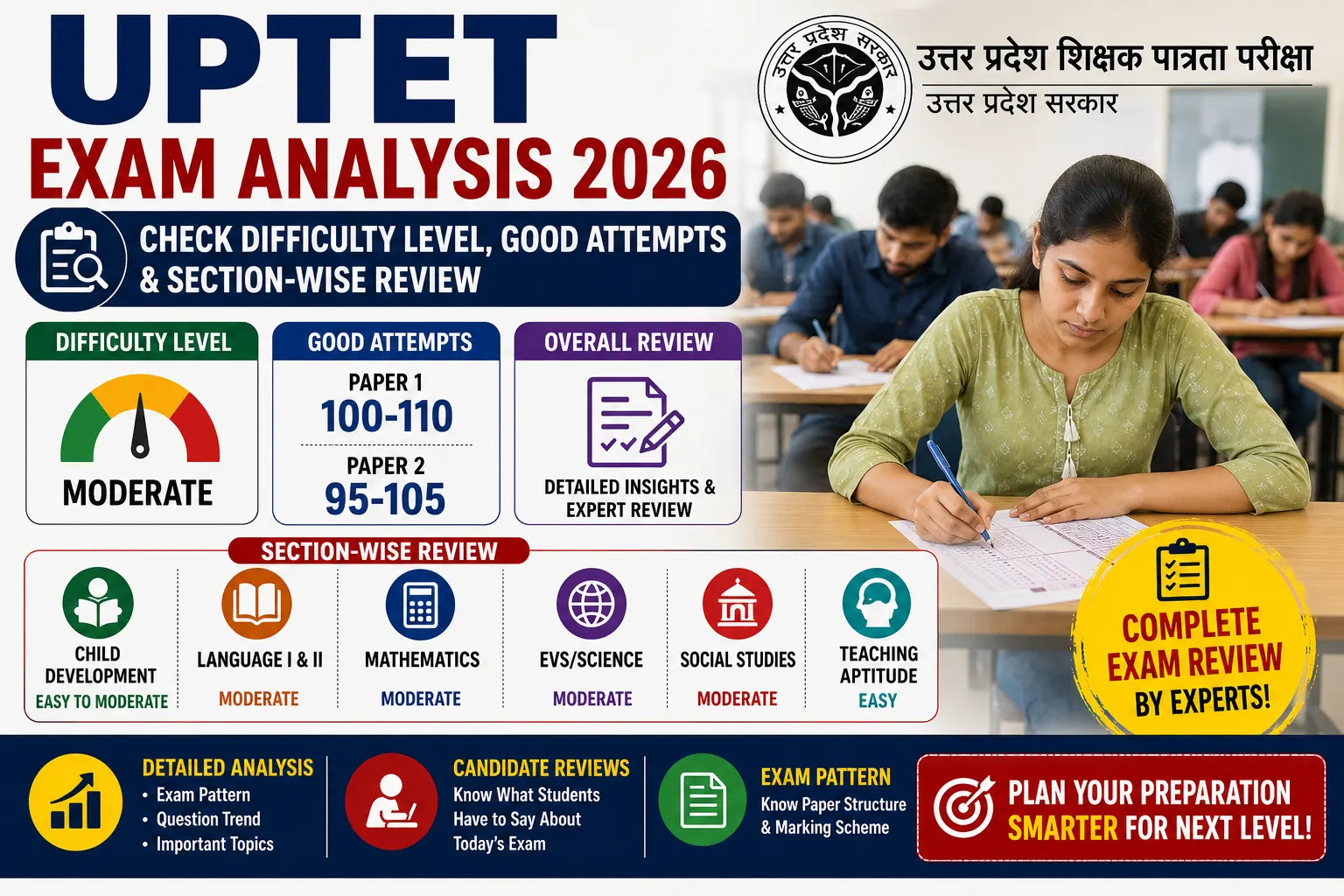
| Overall Paper | Easy to Moderate |
Most candidates described the paper as balanced, with enough opportunities to score well through conceptual preparation.
Good Attempts in UPTET Paper 2
Based on the overall difficulty level and candidate feedback, experts believe that candidates attempting around 107 to 115 questions with good accuracy are likely to remain in a comfortable position.
| Category | Expected Good Attempts |
|---|---|
| Overall | 107–115 Questions |
Since there is no negative marking in UPTET, candidates were able to attempt a higher number of questions confidently.
Section-Wise Exam Analysis
Child Development and Pedagogy (CDP)
The CDP section was one of the easiest parts of the examination. However, instead of asking straightforward definitions, the paper focused on practical classroom situations and child-centered teaching approaches.
Major Topics Asked
- Inclusive Education
- Learning Theories
- Constructivism
- Teaching Methods
- Assessment for Learning
- Classroom Scenarios
- Child Psychology
- Learning Difficulties
Candidates who understood educational theories rather than memorizing definitions found this section highly scoring.
Hindi Language
The Hindi section was balanced and focused more on language pedagogy than pure grammar.
Important Topics
- भाषा विकास
- भाषा शिक्षण
- व्याकरण
- अपठित गद्यांश
- मुहावरे
- पर्यायवाची
- वाक्य शुद्धि
Most candidates completed this section comfortably within the allotted time.
Language II
Language II tested candidates on grammar, reading comprehension, and teaching methodology.
Topics Covered
- Reading Comprehension
- Narration
- Parts of Speech
- Vocabulary
- Error Detection
- Language Pedagogy
- Subject-Verb Agreement
Candidates with regular practice of English pedagogy found the questions manageable.
Mathematics & Science
This section focused more on conceptual understanding than formula-based calculations.
Mathematics Topics
- Number System
- Ratio and Proportion
- Percentage
- Geometry
- Algebra
- Mensuration
- Mathematical Reasoning
Science Topics
- Motion
- Force
- Electricity
- Acids and Bases
- Metals and Non-Metals
- Human Body
- Scientific Reasoning
Most science questions were based on NCERT concepts, making the section easier for well-prepared candidates.
Social Science
The Social Science section consisted of analytical and concept-based questions from History, Geography, Civics, and Political Science.
Important Topics
- Indian Constitution
- Geography
- Indian History
- Social Science Pedagogy
- Environmental Issues
Candidates reported that the section was scoring but required conceptual clarity.
What Was Different in UPTET 2026?
One of the biggest highlights of this year’s paper was the noticeable shift toward competency-based questions.
Instead of testing candidates on rote learning, the exam assessed their ability to apply concepts in real classroom situations. Questions based on pedagogy, teaching strategies, and inclusive education received greater emphasis than in previous years.
This change reflects the evolving pattern of teacher eligibility examinations across the country.
Candidate Feedback
The majority of candidates shared a positive response after the exam.
Some common observations included:
- The paper was easier than expected.
- Child Development and Pedagogy was highly scoring.
- Mathematics required conceptual understanding rather than lengthy calculations.
- Language sections focused on pedagogy.
- Social Science questions were balanced.
- Time management was not a major issue.
Overall, candidates who prepared consistently with NCERT books and previous years’ papers felt confident about their performance.
Memory-Based Topics Reported
Based on candidate feedback, several recurring themes appeared in the examination, including:
- Inclusive Education
- Constructivism
- Child Psychology
- Language Teaching Methods
- Classroom Assessment
- Scientific Concepts
- Mathematical Reasoning
- Indian Constitution
- Environmental Studies
These topics may also prove useful for candidates appearing in the remaining shifts.
Safe Score Analysis
Although UPTET is a qualifying examination, experts believe the following score ranges can help candidates assess their performance.
| Score | Performance |
|---|---|
| 120–150 | Excellent |
| 110–119 | Very Safe |
| 100–109 | Safe |
| 90–99 | Qualifying for General Category |
| 82–89 | Qualifying for Reserved Categories |
Key Takeaways for Upcoming Shifts
Candidates appearing in the remaining shifts should focus on strengthening conceptual understanding instead of memorizing facts.
A few preparation tips include:
- Revise Child Development and Pedagogy thoroughly.
- Practice classroom-based teaching scenarios.
- Study NCERT books carefully.
- Focus on Language Pedagogy.
- Solve previous years’ UPTET and CTET papers.
- Improve conceptual clarity in Mathematics and Science.
- Take mock tests to improve speed and accuracy.