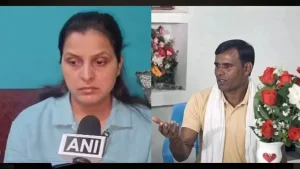
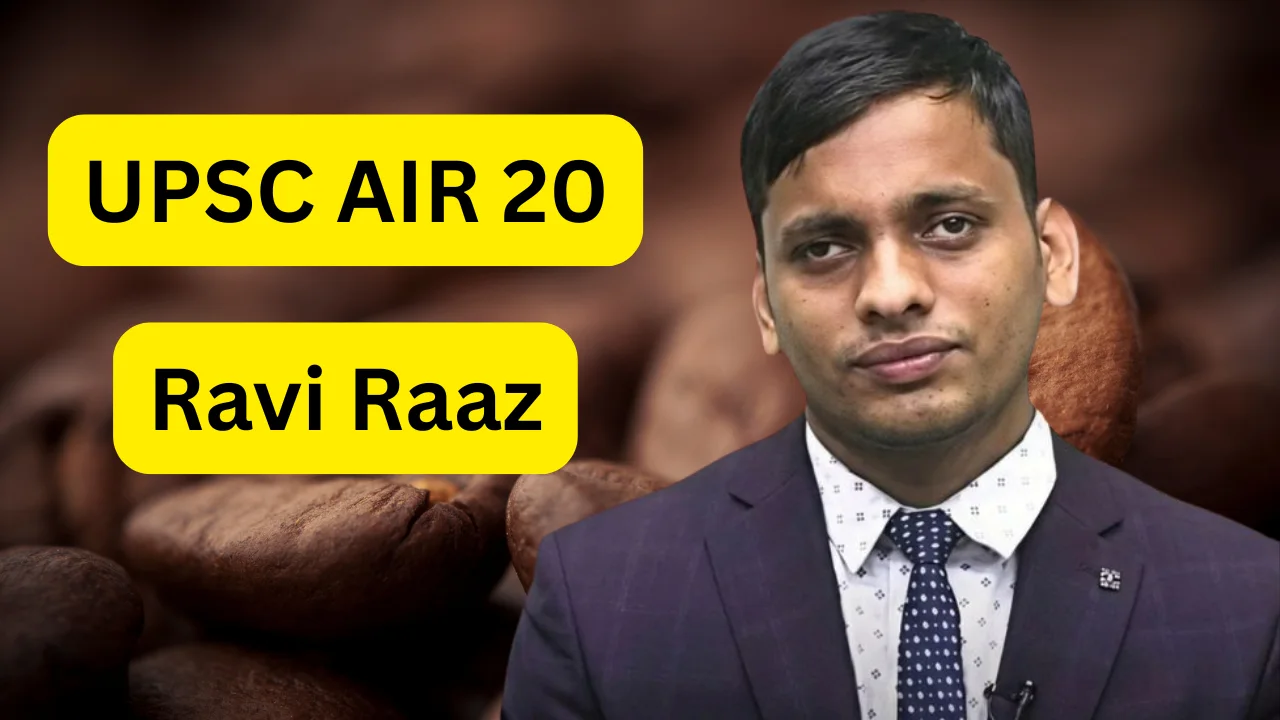
Ravi Raaz, a 27-year-old visually impaired candidate from Nawada district in Bihar, secured All India Rank 20 in the UPSC Civil Services Examination 2025 — becoming the first person in his family to clear the country’s most competitive exam. His mother, Vibha Sinha, sat beside him through every page of preparation — reading textbooks aloud and writing down whatever he dictated.
A Village, a Farmer’s Son, and One Dream
Nawada is a quiet district in southern Bihar. Ravi’s father, Rajan Kumar Sinha, works as a farmer. His mother runs the household. There was no coaching infrastructure, no library, and no family precedent for civil services.
Ravi studied at SRS College in Nawada, completing a BA in Political Science (Honours). The idea of UPSC first entered his mind in Class 9 — not from a teacher or a book, but from a casual conversation among school friends.
“They didn’t pursue it themselves,” he recalls. “But I decided to consider this as my first step in knowing what UPSC is.”
By 2020, that curiosity had become a commitment.
Five Attempts, One Stubborn Direction
Ravi’s path to AIR 20 was not straight. His first three UPSC attempts did not clear. In between, he appeared for the Bihar Public Service Commission (BPSC) examination twice — and failed both times.
His third BPSC attempt, in the 69th session, finally succeeded. He was recommended as a revenue officer. Most candidates would have joined and settled. Ravi didn’t.
“Yes, my bet could have been reversed. I might not have achieved it,” he said. “But I was certain that if I prepared sincerely, I would still be somewhere better.”
His fourth UPSC attempt brought AIR 182 and a recommendation for the Indian Revenue Service (IRS). He joined IRS training — and kept preparing simultaneously.
His fifth attempt produced AIR 20. He now hopes to be allotted the Indian Administrative Service (IAS), with a preference for Bihar or Uttar Pradesh cadre.T
The Woman Who Became His Eyes
Preparing for UPSC means months with thick books, dense current affairs, answer writing practice, and mock interviews. For a visually impaired aspirant from a small Bihar village, the logistics alone could have ended the journey before it began.
Vibha Sinha made it possible — one page at a time.
She is not an educator. She has no background in competitive exams. She is a homemaker who spent years reading textbooks aloud to her son and writing down his dictated answers for practice. No formal training. No compensation. Just patience, repeated every single day.
His father kept the household running on a farmer’s unpredictable income through all five attempts — across years with no guaranteed outcome.
“They believed in me even when the results didn’t come,” Ravi said. “For me, they are my everything.”
How He Actually Prepared — No Expensive Coaching
Ravi’s preparation strategy is one of the most practically useful aspects of his story for the millions of aspirants who cannot afford big-city coaching.
He enrolled in Drishti IAS under the ASMITA programme — a scheme designed for students from economically weaker sections — for both CSE 2024 and CSE 2025. Beyond that, his toolkit was largely free.
For CSAT and Geography, he relied on YouTube videos. For Ethics answer writing, he joined a Telegram mentorship group where he submitted one or two answers and received feedback from a teacher via voice notes and written responses.
He also used AI — selectively. “For Ethics, where strong examples are important, I used AI to generate references from religion, history, and modern science — and then cross-checked them carefully,” he said. “AI can make some things easier, but it cannot replace books. I did not let it replace my core preparation.”
On the persistent concern about Hindi-medium resources, he was direct: “We can either complain or work around the challenge. Resources do exist. If you are serious, you have to make the effort to find them.”
What the System Still Gets Wrong
Ravi’s success does not make him uncritical of the structures around him. He speaks carefully about UPSC rules that affect visually impaired candidates.
Under current UPSC regulations, candidates with visual impairment are excluded from both the Indian Foreign Service (IFS) and the Indian Police Service (IPS). Ravi does not challenge the IPS restriction. The IFS exclusion, however, is harder for him to accept.
“There are tools and technologies available. You can become a visually impaired IAS. You can become a collector. You can become a diplomat,” he said. “If you are excluding someone from a particular service, it means you are not fully inclusive.”
On UPSC’s newer rules around scribes — introduced to prevent cheating — he is supportive in principle but concerned about implementation. His specific worry: the rules treat candidates with low vision and fully blind candidates as a single administrative category, when their practical needs are fundamentally different.
“For a blind candidate who has worked with their own scribe for months, the coordination matters. That scribe knows your pace, your style. An assigned scribe doesn’t,” he explained.
One Line That Defines the Journey
When asked what kept him going through failure after failure, Ravi offered a framing that is simple and rare at the same time.
“Engineering was too far. Medical was out of reach. Banking, Railways, SSC — I had no desire for any of it. There was only one path I wanted, which was CSE.”
He then added: “Sometimes having no option is the best option.”
Ravi Raaz cleared UPSC CSE 2025 with AIR 20. Results were declared on March 6, 2026. The full merit list is available at upsc.gov.in.