

Kerala SET Syllabus and Exam Pattern 2023, LBS Centre for Science & Technology has uploaded State Eligibility Test January 2023 Syllabus, Candidates Can Check Kerala SET 2023 Syllabus & Exam pattern, Kerela SET Topic Wise Syllabus PDF Download, Kerala SET Official website link-https://lbsedp.lbscentre.in/setjan23/
Kerala SET is an exam of State Level. LBS Centre for Science & Technology conducts this exam. It is very important for the candidates to know about the syllabus and exam pattern of the exam. We will discuss about Kerala SET Syllabus and Exam Pattern 2022 through this article. Thus, all the interested candidates should read this article.
About the Kerala SET Exam 2023:
The candidates who will qualify this exam will get the opportunity to teach in higher secondary schools. The exam comprises of two papers. Paper one consists of Aptitude and general knowledge, whereas, Paper two consists of questions from subject specialization of the postgraduate level.
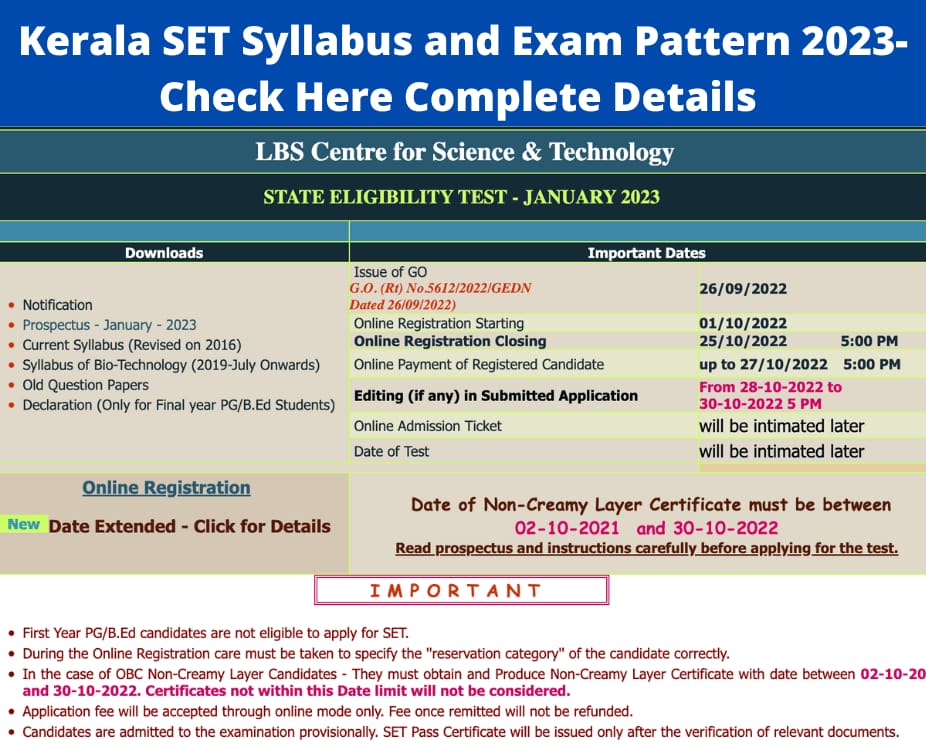
Important Dates of Kerala SET 2023:
Some important dates related to the exam are-
Govt Job Update & Exam Notes के लिए फॉर्म भरे
Date of Notification | 26th September, 2022 |
Start Date of Application & fee payment | 1st October, 2022 |
Last Date of Application | 20th October, 2022 |
Last date of fee payment | 22nd October, 2022 |
Date of correction in form | 23rd to 25th October, 2022 |
Admit Card Release Date | Not announced yet |
Date of Exam | In January, 2023 |
Date of provisional answer key release | Not announced yet |
Date of final answer key release | Not announced yet |
Date of Result | Not announced yet |
Date of application form release for certificate | Not announced yet |
Official website link |
Kerala SET 2023 Selection Criteria:
The candidates will be selected on the basis of the marks that they will score in the written examination.
Required Educational Qualification:
The educational qualification required for being eligible to appear for the exam are-
For Anthropology, French, Commerce, Geology, Gandhian Studies, Philosophy, Sociology, Statistics, Syriac, Latin, Psychology, Music, Journalism, Home Science, German, Social Work, Russian- B.Ed. Degree.
For Maths, Chemistry & Physics- Must have M.Sc. Ed. in the specific subject with at least 50% marks.
For Zoology & Botany- Must have M.Sc. Ed. in the specific subject with at least 50% marks or must have M.Sc. Ed. Degree in Life Science with a minimum of 50% marks.
For Latin- Degree in any discipline with Latin as 2nd language.
For Hindi- B.Ed. Degree in Hindi.
For English- Masters in Communicative English with 50% marks at least& B.Ed. Degree.
Kerala SET 2023 Age Limit:
No prescribed age limit is there for this recruitment.
Application Process of Kerala SET 2023:
The candidates can apply for the exam in the following way-
They should visit lbscentre.in/setjan23/.
Then, they must click on link of “Online Registration”.
Next, they should click on link of “Registered Candidates”.
After that, they must provide the login details.
Then, they should fill up the application form properly and submit it.
Finally, they must save “Confirmation Page”.
Correction of Application Form Kerala SET 2023:
The correction in the application form can be done in the following way-
The candidates must visit lbscentre.in/setjan23/ at first.
Then, they should click on link of “Online Registration”.
After that, they must click on link of “Registered Candidates”.
Next, they should provide the login details.
After that, they must make the required corrections in the application form and then they should submit it.
Finally, they should save “Confirmation Page”.
Application Fee for Kerala SET 2023:
The application fee will be as follows-
Sl. No. | Category | Application Fee |
01 | General and OBC | 1000 rupees |
02 | SC, PWD and ST | 500 rupees |
Kerala SET 2023 Syllabus:
Syllabus for paper 1:
General knowledge syllabus-
General science
Social science
Current affairs
English language and reasoning
Humanities
Teaching aptitude syllabus-
Educational administration
history and policies of education
Foundations of education
Teaching, learning and evaluation
Learning theories and evaluation
Teaching methods
Teaching aptitudes
Communication
Computer and ICT
Research in education
Syllabus for paper 2:
Botany syllabus-
Diversity of landforms
Reproductive biology
Molecular cell biology and heredity
Applied botany
ecology and environment
Functional plant biology and analysis plant Physiology
Commerce syllabus-
Management concept and strategies
Cost and management accounting
Business environment, policy and MIS
Quantitative techniques and research methods
Financial and corporate accounting
Financial management and marketing
Zoology syllabus-
Taxonomy
Applied zoology
animal diversity
Biochemistry
Biostatistics
Biophysics
Cell biology
Bioinformatics
molecular biology
Evolution
Ecology
Ethology
Biodiversity
Biotechnology
Genetics
Physiology
Microbiology
Developmental biology
Immunology
Statistics syllabus-
Probability theory
mathematical methods for statistics
Sample surveys and design of experiments
Distribution in statistics
Multivariate analysis, Stochastic processes and Index numbers
Estimation and testing of hypotheses
Sanskrit syllabus-
History of Sanskrit
Linguistics
Vyakaran
Vedanta
Sahitya
Vrtta and alankar
Nyaya
Jyotisa
Psychology syllabus-
Cognitive processes
Psychopathology
Motivation, emotion and learning
Applied psychology
Personality and social psychology
Psychometry and research methodology
Philosophy syllabus-
Logic
Classical Indian philosophy
Western philosophy
Ethics
Contemporary western philosophy
Contempt of Indian philosophy
Mathematics syllabus-
fundamental concepts
Real and complex analysis
Topology and functional analysis
Linear algebra and matrix theory
Abstract algebra
number theory and differential equations
Malayalam syllabus-
Verse
Visual arts
Linguistic history and grammar
Cultural studies
Pros
Literary theory and Malayalam criticism
Islamic history syllabus-
Islam under the prophet and Pierce caliphs
Islam in India
Muslim dynasties in the middle age
Reform and the revivalist movements in Islam
Modern and contemporary Muslim world
Intellectual contributions of medieval Islam
Hindi syllabus-
Hindi sahitya ka itihas
Adhunik kaal
Western and eastern literary thoughts
Poetics
Prosody
History of Hindi language and structural grammar
Functional Hindi
translation and linguistics
Geology syllabus-
Marine geology
Igneous petrology
physical geology
Planetary geoscience
Stratigraphy
Paleontology
Quaternary geology
Indian geology
Crystallography and mineralogy
Sedimentary petrology
metamorphic petrology
Structural geology
Hydrogeology
Economic geology
Engineering geology
Geochemistry
Field geology
Geoinformatics
Remote sensing
environmental geology
Exploration and mining geology
Geotectonics
French syllabus-
Middle Ages to 17th century
20th and 21st century
18th and 19th century
Linguistics, methodology and fle
Contemporary France
Grammar
Culture and civilization
literary criticism
Francophone literature, culture and civilization
Chemistry syllabus-
Organic chemistry
physical chemistry
inorganic chemistry
Theoretical chemistry
Material chemistry
Analytical chemistry
Medicinal chemistry
green and environmental chemistry
Polymers, etc.
Anthropology syllabus-
Meaning and scope of social and cultural anthropology
Family, marriage and kinship
Social stratification
Economic organizations
Man’s place in animal Kingdom
Biological basis of life
Heredity and variations
Human Genetics
The emergence of man fossil evidence
Basic concepts of anthropology
Religious organizations
Theories of organic evolution
introduction to human evolution
Nature and configuration of culture
Political organization and social control
Meaning and scope of biological anthropology
Concept of race, ethnicity and population
Science and scientific research
The ethnographic approach in anthropological research
Quantitative analysis
The tribes of India
social disabilities
Composition of the Indian population
Application of biological anthropology
biological anthropology in service of human society
Hindu religious and philosophical traditions
Construction of research design
Field work tradition in anthropology
Quantitative analysis
basic techniques of data collection
Process of social changes
Indian education system
Approach to study of Indian culture and civilization
Aesthetic and creative aspects of Indian culture
The ethnographic approach in anthropological research
Changing village India
Qualitative analysis
Structuralism and post structuralism
Structural functionalism
method andtheory in socialcultural and developmental anthropology
Ecological, medical and Economic anthropology
Preparation of anthropological research report
Evolutionism
Diffusionism
Functionalism
Continuum
Economics syllabus-
macroeconomics theory and applications
Microeconomics theory and applications
Money, banking, public finance and international trade
Economic development
environmental economics
Quantitative methods for economic analysis
Development experiences of India
development experiences of Kerala
Arabic syllabus-
prose
Grammar
Prosody
Arabic criticism
Journal Arabic
Translation
Indo Arabic culture
Travel and tourism
Encyclopaedic work in Arabic
Contemporary Arab world
English syllabus-
Chaucer’s age
Early renaissance in England
new classical age
Victorian age
Early feminist writing
Romanticism
African literature and colonialism
20th century and contemporary British literature
American, Indian and new literatures in English
English language teaching
History and structure of English
Literary theory and criticism
Gandhian studies syllabus-
Making of the Mahatma
Gandhi and the modern world
Fundamentals of Gandhian thoughts
Political and economic thought
Piece of studies
conflict resolution
Social and educational ideas
Geography syllabus-
Meaning, nature and scope of geography
Resource geography
Indian geography
Geoinformatics
Development in geographical thought
foundation In human geography
Urban and regional geography
physical geography
Traditions in geography
German syllabus-
Linguistics
Literature
Methods of teaching German as a foreign language
History of western philosophy and German culture
History syllabus-
Historical methods
Modern Indian history
Kerala history
Historiography
Select themes world history
Ancient and medieval Indian history
Home science syllabus-
Human development and family relations
Research and development in family and community service
Textile science and fashion designing
Marriage and family relations
Food Science
nutrition
Dietetics
advances and assessment of children
Family resources management
Extension and development communication
Journalism syllabus-
Dimensions of mass communication
Reporting and editing
Communication research
Media history and laws
Electronic and digital media
Advertising
Public relations
corporate communications
media management
Kannada syllabus-
Modern, medieval and ancient literature
Research methodology
textual criticism
Journalism and computer knowledge
Folklore and cultural studies
History of Kannada language and linguistics
Prosody
literary criticism
Latin syllabus-
Grammar
Poetry
History
Prose
Drama
short story
Translation
Physics syllabus-
Mathematical physics
quantum mechanics
electromagnetic theory
Classical mechanics
nuclear and particle physics
Electronics
statistical mechanics
Condensed matter physics
Atom and molecular physics
Music syllabus-
History of music
Lakshanagranthas
Composers
Vedic music
Talas
Ragalakshana
Music and temples
Evolution of musical concerts
Exposition of pallavi
Manodharmasangeetha
music and yoga
Music and mathematics
music therapy
Music and Physiology
modern trends in music
Advanced knowledge of musical prosody
Musical instruments
Political science syllabus-
Modern political analysis
Comparative politics
Public administration
political thoughts
International relations
Indian government and politics
Russian syllabus-
Russian grammar
morphology and syntax
Modern Russian language
Russian cultural history
Russian literature
Sociologist syllabus-
Disciplines, concepts and processes of sociology
Social Research methods and statistics
Theory and practice of development
Sociology of India
Sociological theories
globalization and emerging challenges
Social work syllabus-
History and philosophy of social work
Sociology
Social casework
Community organization
Social group work
Counseling
Developmental psychology
social legislations
Project planning
social work research and statistics
Tamil syllabus-
Literature
History
Grammar
literary theories
Philosophy
Folklore
Anthropology
Communication
Tourism
Syriac syllabus-
Grammar
Structure
History
Poetry
Literature
current affairs
Biotechnology syllabus-
Cell biology
molecular biology
Genetics
Bioinformatics
Biostatistics
Microbiology
pharmaceutical biotechnology
Immunology
biophysics and instrumentation
Enzymology
Biochemistry
Food and dairy biotechnology
environmental biotechnology
Nanobiotechnology
Bioethics
Biosafety
Plant and animal biotechnology
Genetic engineering
Patent laws in biotechnology
Computational biology
Urdu syllabus-
Urdu literature
Urdu language
Habits of Sufi
Guilds
Prose
Poetry
Vitan vati and its characteristics
Messinian, etc.
Exam Pattern of Kerala SET 2023:
The exam pattern has been mentioned below-
The exam will be held via offline mode.
There will two papers- Paper 1 & 2.
Time allotted for each paper will be 2 hours.
Paper 2 will comprise of specialized subject (among list of various subjects).
Paper 2 will comprise of 120 questions, except Statistics & Mathematics which will contain 80 questions each carrying 1.5 marks.
Subjects | Total Questions | Total Marks |
Paper 1- G.K. | 60 | 60 |
Paper 1- Teaching Aptitude | 60 | 60 |
Paper 2- Specialization Subject | 120 | 120 |
Total | 240 | 240 |
Kerala SET 2023 Admit Card:
The admit card can be availed from the website lbscentre.in/setjan23/. It will be released a few days before the exam.
Cut-Off Marks of Kerala SET 2023:
The cut off marks will be released a few days after the exam along with the result.
Kerala SET 2023 Result:
The result will be released on the website lbscentre.in/setjan23/, a few days after the exam.
We hope that you liked this article regarding the Kerala SET Syllabus and Exam Pattern 2022. You can share your opinions about this article via your precious comments.
FAQs for Kerala SET 2023 Notification, Syllabus & Exam pattern
Can the syllabus be availed through offline mode?
No, the syllabus cannot be availed through offline mode.
How can the application be done?
The application can be done by visiting the website lbscentre.in/setjan23/.
Can the application be done offline?
No, application cannot be done offline.
Is there any relaxation in application fee for reserved category candidates?
Yes, there is relaxation in application fee for reserved category candidates.
When will the exam be held?
The exam will be held in the month of January, 2023.
Will the exam be held via online mode or offline mode?
The exam will be held via offline mode.
What will be the duration of the Exam?
The duration for each paper will be 2 hours.
What is the last date of application?
The last date of application was October 20, 2022.


