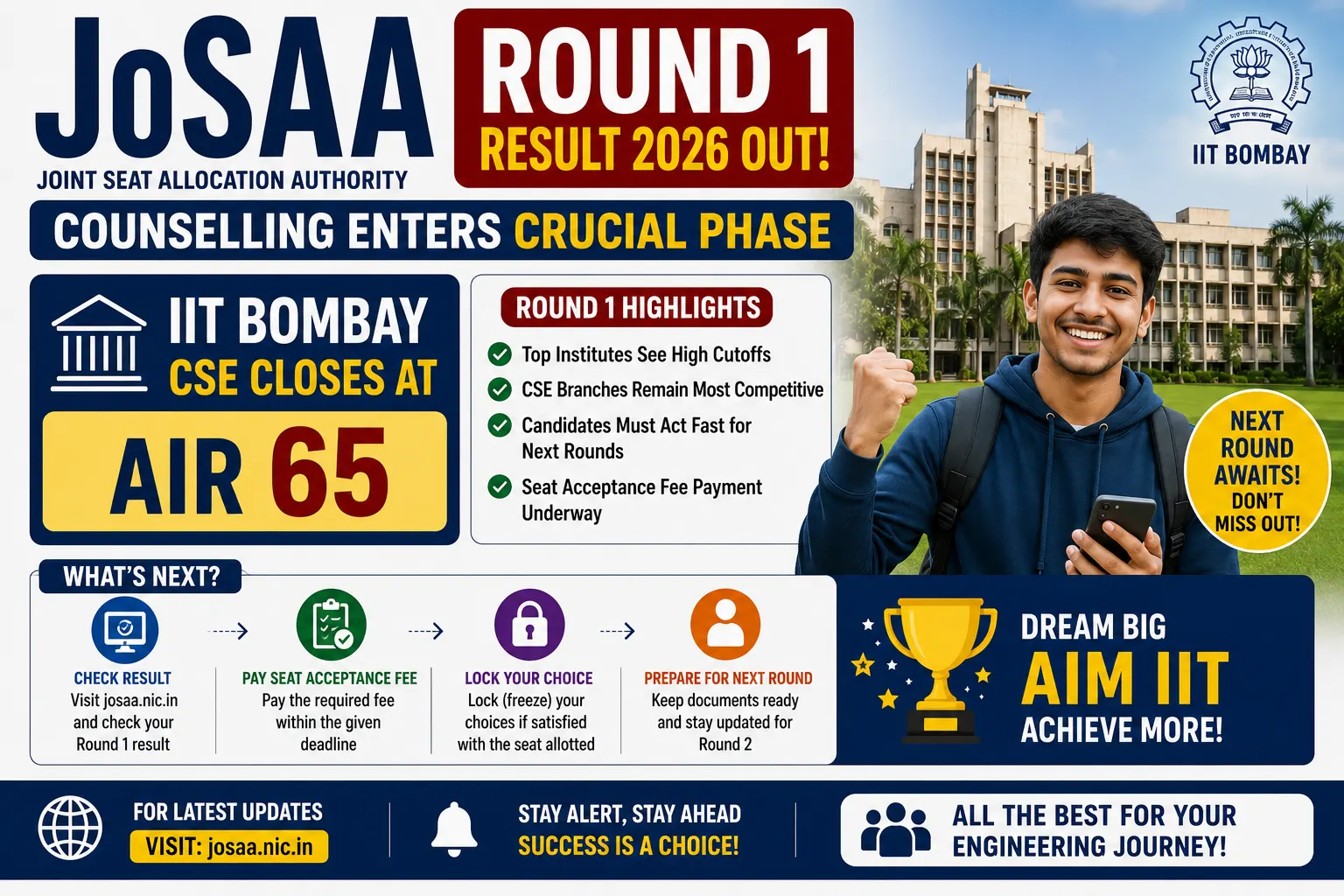
JoSAA Round 1 Result 2026 Out: IIT Bombay CSE Closes at AIR 65, Counselling Enters Crucial Phase.JoSAA Round 1 Seat Allotment Result 2026 has been declared. IIT Bombay CSE closed at AIR 65, while candidates must complete reporting and fee payment by June 26.
The wait is finally over for lakhs of engineering aspirants across the country. The Joint Seat Allocation Authority (JoSAA) has announced the Round 1 seat allotment result for the 2026 counselling process, marking the beginning of the admission phase for IITs, NITs, IIITs and other participating institutes.
For many students, the result has brought clarity on where they stand in this year’s highly competitive admission race. For others, it offers the first opportunity to enter the counselling process with hopes of securing a better seat in the upcoming rounds.
Alongside the allotment results, JoSAA has also released the opening and closing ranks for Round 1, providing valuable insights into admission trends at the country’s premier engineering institutions.
IIT Bombay CSE Once Again Tops the Competition
If there was one trend that stood out from the Round 1 data, it was the continued dominance of Computer Science Engineering.
IIT Bombay’s Computer Science Engineering programme emerged as the most competitive seat in the country, closing at All India Rank (AIR) 65 in the Open category. The numbers reaffirm what has become a familiar pattern over the past few years—students continue to prefer computer science and technology-focused programmes over traditional engineering branches.
IIT Delhi’s CSE programme closed at AIR 123, while IIT Madras closed its Computer Science seats at AIR 149. Even newer-age programmes such as Artificial Intelligence and Data Analytics witnessed exceptionally strong demand, with IIT Madras closing the course at AIR 226.
Education experts believe the growing influence of artificial intelligence, software development, and data-driven careers is continuing to shape students’ preferences during counselling.
What the Round 1 Data Reveals
This year’s opening and closing ranks suggest that top IITs remain extremely competitive, particularly for branches linked to technology and computing.
While Computer Science continues to dominate, programmes such as Mathematics & Computing, Electrical Engineering, and AI-related specialisations are also attracting top-ranking candidates.
Interestingly, traditional branches like Mechanical, Civil, and Chemical Engineering still hold strong value at leading IITs, although their cut-offs remain comparatively lower than those of computer science-related disciplines.
The Round 1 numbers also indicate that significant competition exists not only for IITs but also for leading NITs and IIITs, where demand for CSE remains exceptionally high.
Counselling Process Now Enters a Crucial Phase
With the first allotment list now available, attention shifts from result checking to admission formalities.
Candidates who have secured a seat must complete online reporting, upload required documents, and pay the seat acceptance fee within the specified timeline.
Missing any of these steps could result in the cancellation of the allotted seat, making the next few days extremely important for students and parents alike.
Important Dates Candidates Should Remember
| Event | Date |
|---|---|
| Round 1 Seat Allotment Result | June 13, 2026 |
| Online Reporting Begins | June 13, 2026 |
| Document Upload & Verification | June 13–26, 2026 |
| Last Date for Fee Payment | June 26, 2026 |
| Resolution of Payment Issues | June 29, 2026 |
| Final Response to Verification Queries | June 29, 2026 |
What Should Candidates Do After Getting a Seat?
Receiving an allotment does not automatically confirm admission.
Students must:
- Accept the allotted seat.
- Upload all required documents.
- Pay the seat acceptance fee.
- Respond to verification queries, if raised.
- Complete online reporting before the deadline.
Only after these steps are successfully completed will the seat remain secured for further admission procedures.
Freeze, Float or Slide? Choosing the Right Option Matters
One of the most important decisions candidates now face is selecting the appropriate counselling option.
Students satisfied with their allotted seat can choose the Freeze option, which locks the seat and removes them from future rounds.
Those hoping for a better institute can opt for Float, while candidates seeking a better branch within the same institute may select Slide.
Experts advise students to carefully evaluate their rank, preferred branch, and expected cut-off movement before making a decision.
What This Means for Students Waiting for Better Options
Not everyone receives their dream branch in the first round, and that is perfectly normal.
Historically, JoSAA counselling witnesses considerable movement in later rounds as some candidates withdraw, upgrade their seats, or shift to other institutions.
As a result, students who have not secured their preferred branch should avoid making hasty decisions and closely monitor subsequent counselling rounds.
Many successful IIT and NIT admissions in previous years were finalized only after multiple rounds of seat allocation.
A Strong Year for Technology Programmes
One clear takeaway from the 2026 counselling data is the growing popularity of technology-focused programmes.
Computer Science, Artificial Intelligence, Data Analytics, and Mathematics & Computing continue to attract the country’s top-ranked candidates. This trend reflects changing industry demands, where digital technologies are increasingly shaping career opportunities.
The preference patterns observed this year suggest that technology-driven courses are likely to remain highly competitive in future admission cycles as well.