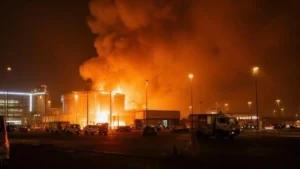
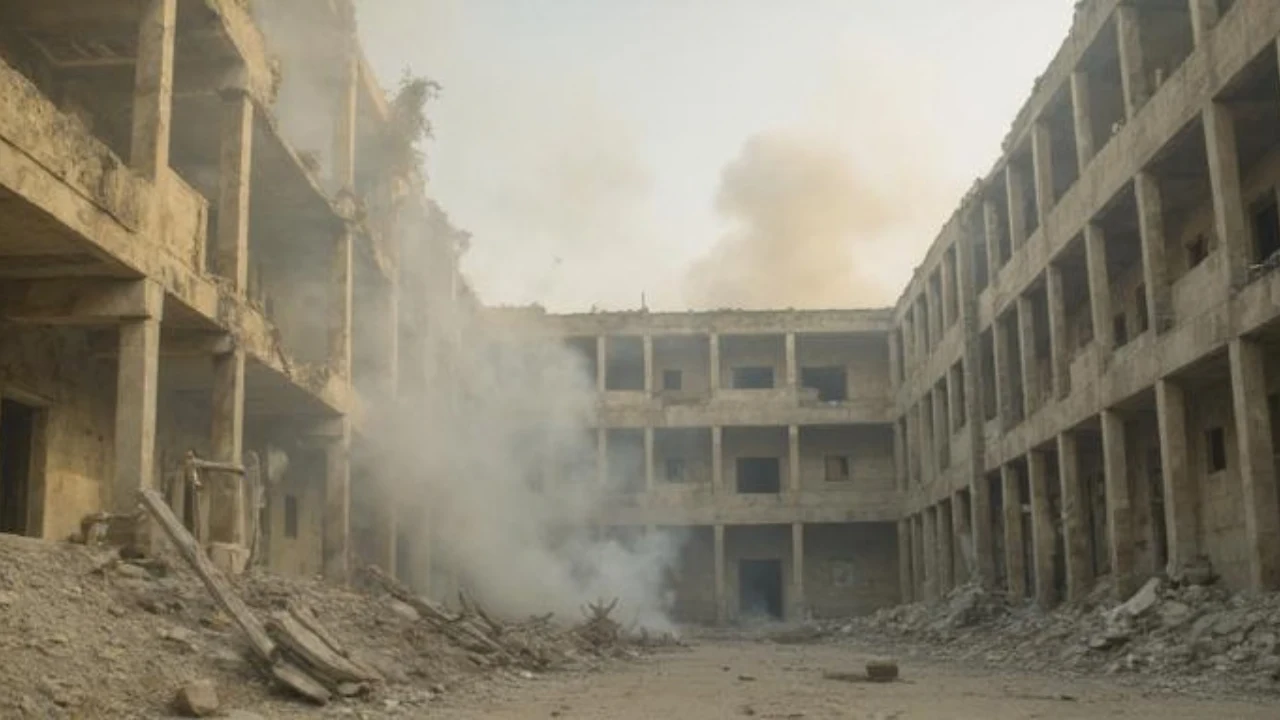
China announced on Friday, March 13, that it will provide USD 200,000 in emergency humanitarian assistance to Iran following a devastating airstrike on a girls’ primary school in Minab, southern Iran, that killed around 150 people and wounded nearly 100 more, with many of the dead believed to be students.
The aid, channelled through the Red Cross Society of China to the Iranian Red Crescent Society, represents Beijing’s most tangible response yet to one of the most shocking single incidents in the ongoing conflict between Iran and the joint US-Israel military campaign.
The attack and what is known
According to a United Nations statement issued on March 1, missiles struck a girls’ primary school in Minab, a town in the southern Iranian province of Hormozgan. The school was situated near an Islamic Revolutionary Guard Corps (IRGC) base — a facility that has reportedly been targeted in previous strikes. Iran has squarely blamed the United States and Israel for the attack.
The US military’s Central Command (Centcom) said it was looking into reports of the incident, while Israel’s military stated it was not aware of any IDF operations in the area at the time. Neither country has accepted responsibility. The proximity of the school to an IRGC installation is likely to become a central point of contention in any further investigation or international debate over the strike.
China’s response — condemnation and aid
Speaking at a media briefing in Beijing, Chinese Foreign Ministry spokesperson Guo Jiakun conveyed deep condolences to the families of those killed and made clear that Beijing views the targeting of a school as a grave breach of international norms.
He stated that attacks on civilians and non-military targets are unacceptable under any circumstances, and that striking schools and harming children constitutes a severe violation of international humanitarian law — crossing, in his words, the bottom line of human morality and conscience.
He reaffirmed China’s commitment to continuing support for Iran and its people through what he described as a spirit of humanitarianism.
China’s broader stance on the conflict
The aid pledge sits within a much larger diplomatic posture that Beijing has maintained since hostilities between Iran and the US-Israel alliance escalated. China, a long-standing strategic partner and close ally of Tehran, has consistently called for an immediate ceasefire and an end to all military operations.
That call has grown louder in the wake of the assassination of Iranian Supreme Leader Ayatollah Syed Ali Khamenei — a development that dramatically raised the stakes of the conflict and sent shockwaves through the region. Guo reiterated China’s position on Thursday, urging all parties to halt military operations at once, avoid further escalation, and prevent the regional turmoil from spilling over into broader damage to global economic growth.
Key facts at a glance
| Detail | Information |
|---|---|
| Location of attack | Minab, Hormozgan Province, southern Iran |
| Type of institution struck | Girls’ primary school |
| Casualties | ~150 killed, ~100 wounded |
| Date of UN statement on attack | March 1, 2026 |
| Aid amount pledged by China | USD 200,000 |
| Aid channelled through | Red Cross Society of China → Iranian Red Crescent Society |
| US response | Centcom said it was “looking into” reports |
| Israeli response | Military said it was “not aware” of IDF operations in the area |
| Proximity factor | School located near an IRGC base |
Why this matters — the bigger picture
Several dimensions of this story extend well beyond the immediate humanitarian response.
The scale of the casualties — approximately 150 dead at a single school — places this among the most lethal strikes on a civilian educational institution in recent memory, drawing inevitable comparisons to other devastating attacks on schools in conflict zones worldwide.
The location near an IRGC base raises difficult questions under international humanitarian law about the principle of proportionality and distinction — the legal obligation to differentiate between military targets and civilian populations. Even if the base itself was a legitimate military target, the presence of a functioning school in close proximity significantly complicates any justification for the strike.
China’s aid, while modest in dollar terms relative to the scale of the disaster, carries significant symbolic and diplomatic weight. It reinforces Beijing’s positioning as a counterweight to Western military action in the Middle East and strengthens its standing in Tehran at a moment when Iran is under severe pressure.
The conflict has also already had measurable ripple effects on global trade. Iran’s position astride the Strait of Hormuz — through which a substantial portion of the world’s oil supply passes — means that prolonged instability carries serious implications for energy markets and global supply chains, a concern Beijing explicitly referenced in its call for de-escalation.
The question of accountability for the school strike remains unresolved, and with neither the US nor Israel accepting responsibility, international pressure for an independent investigation is likely to mount in the days ahead.