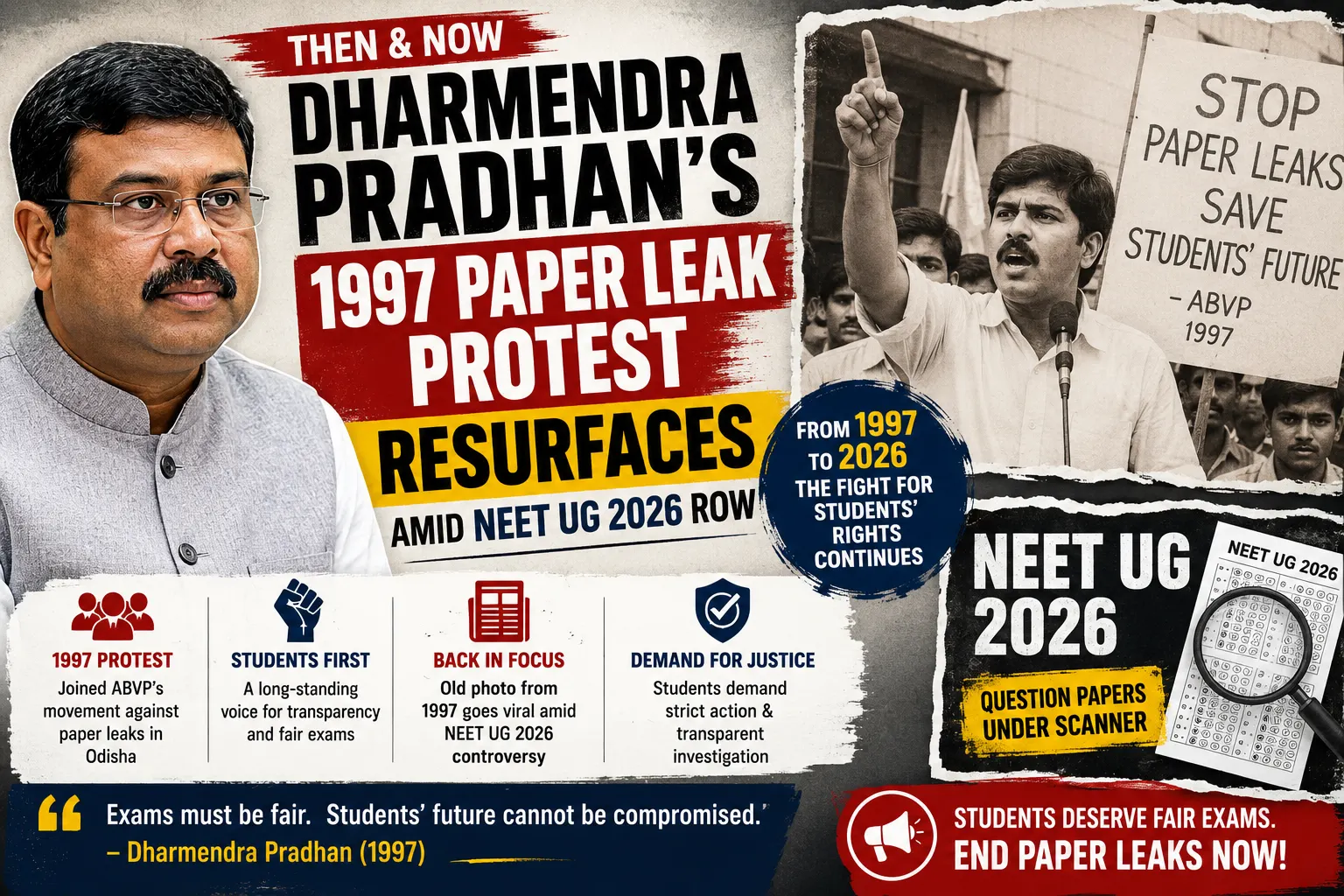
Dharmendra Pradhan’s 1997 Paper Leak Protest Resurfaces Amid NEET UG 2026 Row.The ongoing NEET UG 2026 paper leak controversy has brought an incident from nearly three decades ago back into public discussion. Old photographs and reports showing Union Education Minister Dharmendra Pradhan participating in a student protest against an alleged examination paper leak in Odisha in 1997 have resurfaced on social media and across news platforms.
The revival of these images has sparked widespread political debate, with many drawing comparisons between Pradhan’s role as a student leader demanding accountability in the 1990s and his current position as the country’s Education Minister during one of the biggest examination controversies in recent years.
Dharmendra Pradhan’s 1997 Protest Explained
Before entering mainstream politics and eventually becoming Union Education Minister, Dharmendra Pradhan was an active student leader associated with the Akhil Bharatiya Vidyarthi Parishad (ABVP).
In 1997, following allegations of a question paper leak in a state-level competitive examination in Odisha, ABVP organized protests demanding a fair investigation and strict action against those responsible.
One of the largest demonstrations took place outside the Odisha Secretariat in Bhubaneswar, where a large number of students gathered to voice their concerns over the integrity of the examination system.
According to accounts from people associated with the protest, police later dispersed the gathering through a lathi charge, during which several protesters were injured. Reports also claim that Dharmendra Pradhan suffered injuries during the protest.
Why Is the Incident Being Discussed Again?
The nearly 30-year-old protest has returned to public attention because of the ongoing NEET UG 2026 paper leak controversy.
As allegations surrounding the medical entrance examination continue to generate nationwide protests, many social media users have shared photographs of Pradhan from the 1997 agitation. Critics argue that the images highlight a contrast between his past role as a student leader demanding transparency and his current responsibility as the minister overseeing India’s education system.
Supporters, however, point out that his participation in the 1997 protest reflected his commitment to student issues even before entering government.
NEET UG 2026 Protest Movement Expands
The NEET UG controversy has gradually evolved into a nationwide movement.
What initially began as demonstrations in Delhi has now spread to several major cities, including Mumbai, Bengaluru, Hyderabad, Kolkata and Patna. Student organizations and various groups have continued to demand stronger action against those responsible for alleged examination irregularities.
Among the major demands raised by protesters are:
- A transparent investigation into the alleged paper leak.
- Stronger safeguards for future competitive examinations.
- Greater accountability in examination management.
- Institutional reforms to prevent similar incidents.
Meanwhile, the Central Government has maintained that investigations are underway, several arrests have been made in connection with the alleged irregularities, and additional reforms are being introduced to strengthen examination security.
NEET Topper’s Remarks Add a New Dimension
The debate intensified further after NEET UG 2026 All India Rank (AIR) 2 holder Panshul Bansal explained why he chose not to participate in the ongoing protests.
Instead of joining demonstrations, Bansal said he treated the cancellation of the original examination as an opportunity to improve his preparation. He focused on studying, revising weak areas and improving his score for the re-examination.
His remarks received mixed reactions from students. While many appreciated his personal decision to prioritize academics, others argued that top-ranking students should also support efforts aimed at improving transparency in the examination system.
Political Debate Continues
The resurfacing of the 1997 protest has added a significant political dimension to the NEET UG controversy.
Opposition leaders have referred to Pradhan’s earlier activism while questioning the government’s handling of the current situation. At the same time, the government has reiterated that agencies are actively investigating the alleged paper leak and that strict measures are being taken against those found responsible.
The discussion has moved beyond a single protest and has evolved into a broader conversation about examination reforms, student trust and accountability in India’s education system.
Why This Story Matters
Competitive examinations determine the future of millions of students every year. Any allegation of paper leaks or irregularities naturally raises serious concerns about fairness and equal opportunity.
The renewed focus on Dharmendra Pradhan’s reported involvement in the 1997 protest has become symbolic of a larger debate over consistency in public life, institutional accountability and the need to restore confidence in India’s examination process.
Regardless of differing political views, the ongoing discussion has once again highlighted the importance of conducting transparent, secure and credible examinations that protect the interests of students across the country.