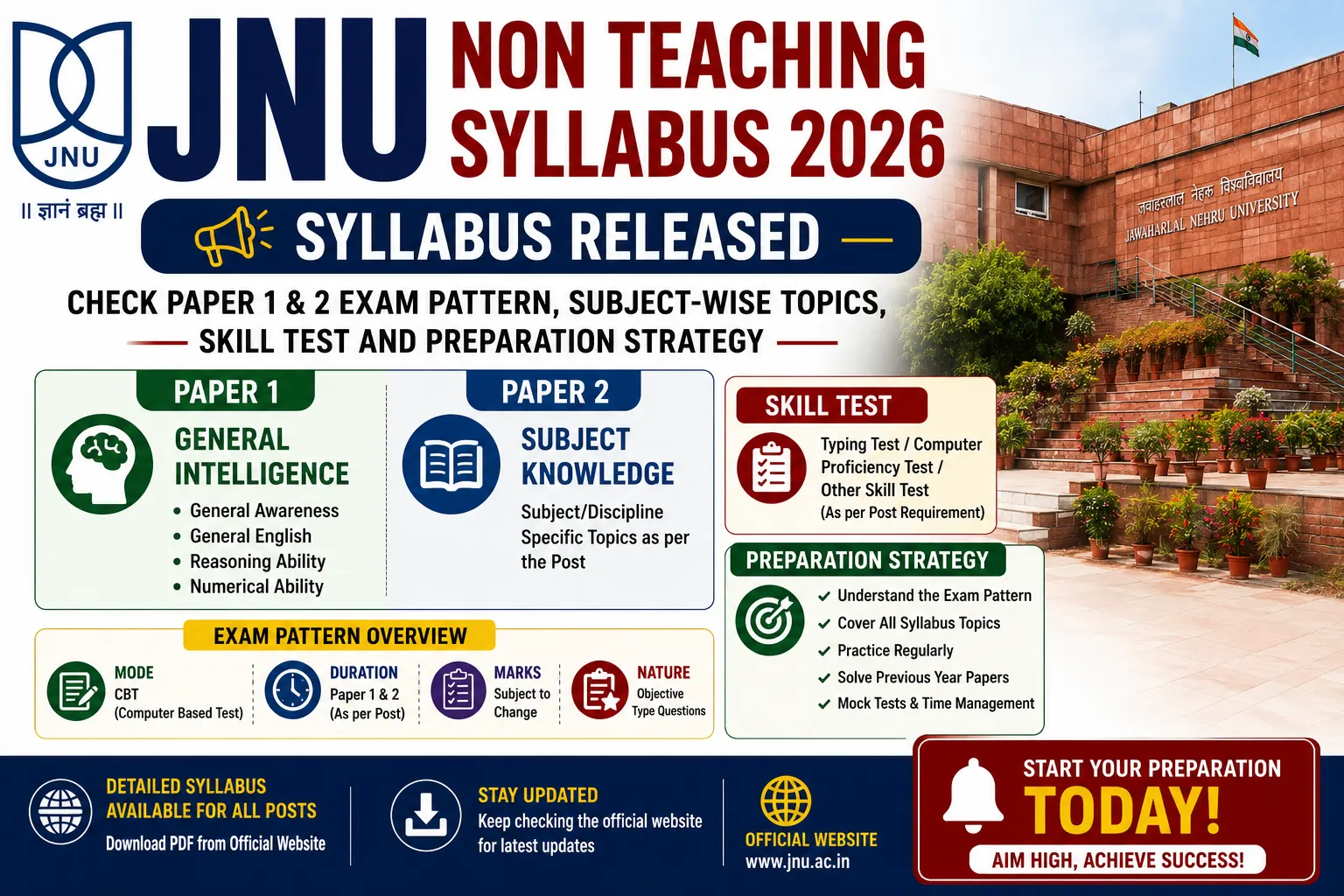
JNU Non Teaching Syllabus 2026 Released: Check Paper 1 & 2 Exam Pattern, Subject-Wise Topics, Skill Test and Preparation Strategy.Jawaharlal Nehru University (JNU) has released the detailed syllabus and examination pattern for the JNU Non Teaching Recruitment 2026, offering opportunities across various Group A, Group B, and Group C posts. The recruitment has attracted significant attention from candidates across the country because it offers stable Central University jobs in administrative, technical, library, engineering, and support services.
As the recruitment process moves forward, understanding the latest syllabus has become one of the most important aspects of preparation. Education experts believe that many candidates spend months preparing without following the official syllabus, resulting in unnecessary effort on low-priority topics. Candidates who build their preparation around the prescribed syllabus generally perform better in the Computer-Based Test (CBT).
The JNU Non Teaching recruitment process consists of Paper I, which is common for all candidates, followed by Paper II, which evaluates post-specific professional knowledge. Depending on the post applied for, candidates may also have to appear for a Skill Test or Interview.
JNU Non Teaching Recruitment 2026
Before beginning preparation, candidates should understand the basic structure of the examination.
| Particulars | Details |
|---|---|
| Conducting Authority | Jawaharlal Nehru University (JNU) |
| Recruitment Name | JNU Non Teaching Recruitment 2026 |
| Total Vacancies | 267 |
| Examination Mode | Computer-Based Test (CBT) |
| Papers | Paper I & Paper II |
| Skill Test | Applicable for selected posts |
| Interview | Only for Group A posts |
| Negative Marking | 0.25 mark for every incorrect answer |
The recruitment includes vacancies for administrative, technical, engineering, library, computer, hospitality, and several other non-teaching positions.
JNU Non Teaching Selection Process 2026
The selection procedure varies depending on the category of the post.
Group A Posts
Candidates applying for Group A posts have to qualify:
- Paper I
- Paper II
- Interview / Personality Test
Group B Posts
Selection generally includes:
- Paper I
- Paper II
- Skill Test (where applicable)
Group C Posts
Candidates are selected through:
- Paper I
- Paper II
- Skill Test (for applicable posts)
Candidates applying for typing or stenography-related posts must also qualify the prescribed skill test before final selection.
JNU Non Teaching Exam Pattern 2026
The written examination is divided into two papers.
Paper I Exam Pattern
Paper I evaluates candidates’ general aptitude and is common for all posts.
| Subject | Questions | Marks |
|---|---|---|
| General Awareness | 30 | 60 |
| Reasoning Ability | 35 | 70 |
| Mathematical Ability | 35 | 70 |
| English/Hindi Language | 30 | 60 |
| Computer Awareness | 20 | 40 |
| Total | 150 | 300 |
Duration: 2 Hours
Important Highlights
- Computer-Based Examination
- Objective-type Multiple Choice Questions
- Two marks for every correct answer
- 0.25 mark deducted for every incorrect answer
Because the examination follows negative marking, candidates should avoid unnecessary guesswork.
Paper II Exam Pattern
Paper II evaluates candidates’ professional knowledge related to the post they have applied for.
| Particulars | Details |
|---|---|
| Question Type | Multiple Choice Questions |
| Total Questions | 50 |
| Maximum Marks | 100 |
| Duration | 90 Minutes |
Unlike Paper I, the syllabus of Paper II differs according to each post.
JNU Non Teaching Syllabus 2026
The syllabus is divided into Paper I and Paper II.
Paper I remains common for all candidates, whereas Paper II contains domain-specific subjects.
Paper I Syllabus
General Awareness
Questions are asked from both current affairs and static General Knowledge.
Important topics include:
- Current Affairs
- Indian History
- Indian Constitution
- Indian Polity
- Geography
- Indian Economy
- Science and Technology
- Art and Culture
- Environment
- Government Schemes
- Awards and Honours
- Sports
- National and International Organisations
- Important Days
- Books and Authors
Reading newspapers and monthly current affairs magazines can significantly improve performance in this section.
Reasoning Ability
Reasoning evaluates analytical thinking and decision-making ability.
Major topics include:
- Analogies
- Coding-Decoding
- Blood Relations
- Number Series
- Alphabet Series
- Direction Sense
- Classification
- Logical Reasoning
- Syllogism
- Statement and Conclusion
- Statement and Assumption
- Decision Making
- Analytical Reasoning
- Figure Series
- Visual Memory
- Non-Verbal Reasoning
Experts often consider Reasoning one of the highest-scoring sections if candidates practice regularly.
Mathematical Ability
This section tests numerical aptitude and problem-solving skills.
Important topics include:
- Number System
- Simplification
- Percentage
- Average
- Ratio and Proportion
- Profit and Loss
- Discount
- Simple Interest
- Compound Interest
- Time and Work
- Pipes and Cistern
- Time, Speed and Distance
- LCM and HCF
- Decimals
- Fractions
- Mensuration
- Data Interpretation
- Basic Algebra
Consistent practice is the key to improving both speed and accuracy.
English/Hindi Language
Candidates can expect questions from grammar, vocabulary, and comprehension.
Important topics include:
- Vocabulary
- Grammar
- Sentence Structure
- Error Detection
- Synonyms
- Antonyms
- Fill in the Blanks
- Reading Comprehension
- One Word Substitution
- Idioms and Phrases
- Active and Passive Voice
- Direct and Indirect Speech
- Sentence Rearrangement
- Spellings
Candidates should regularly read newspapers and practice grammar exercises to improve language skills.
Computer Awareness
Computer Awareness is one of the easiest scoring sections if prepared properly.
Important topics include:
- Computer Fundamentals
- Hardware
- Software
- Operating Systems
- MS Word
- MS Excel
- MS PowerPoint
- Internet
- Networking
- Cyber Security
- Database Basics
- Memory Devices
- Input and Output Devices
- Storage Devices
Candidates should also stay updated with basic digital technologies and office applications.
Paper II Syllabus (Post-Wise)
Paper II evaluates professional knowledge related to the respective post.
Administrative Posts
For posts such as Assistant Registrar, Section Officer and Senior Assistant, candidates should prepare:
- Establishment Rules
- CCS Conduct Rules
- CCS (CCA) Rules
- General Financial Rules (GFR)
- National Pension System
- Leave Rules
- Pay Fixation
- Income Tax
- LTC
- CGHS
- Reservation Policy
- University Administration
- University Act
- Statutes and Ordinances
- Executive Council
- Academic Council
- Finance Committee
System Analyst
Major topics include:
- Computer Fundamentals
- Programming Concepts
- Database Management
- Networking
- Information Systems
- Cyber Security
- Operating Systems
- Data Analysis
- Software Applications
Assistant Librarian & Professional Assistant
Candidates should prepare:
- Library Science
- Library Classification
- Cataloguing
- Information Retrieval
- Library Automation
- Digital Libraries
- ICT Applications
- Documentation
- Preservation of Library Resources
Executive Engineer (Civil)
Important topics include:
- RCC Design
- Surveying
- Soil Mechanics
- Building Materials
- Structural Engineering
- Water Supply
- Estimation and Costing
- Green Buildings
- Construction Management
Executive Engineer (Electrical)
Topics include:
- Electrical Machines
- Power Distribution
- Internal Electrification
- Substations
- HVAC Systems
- Solar Power
- Fire Alarm Systems
- Energy Conservation
Computer Operator
Candidates should focus on:
- Computer Fundamentals
- MS Office
- Database Management
- Networking
- Office Automation
- Practical Computer Applications
Assistant Manager (Guest House)
Topics include:
- Hospitality Management
- Front Office Operations
- Housekeeping
- Catering Management
- Customer Service
- Event Management
- Inventory Management
Statistical Assistant
Important topics include:
- Probability
- Sampling Techniques
- Correlation
- Regression
- Time Series
- Statistical Inference
- Data Interpretation
- Basic Econometrics
Candidates should prepare the domain-specific syllabus according to the post mentioned in their application.
Skill Test for Selected Posts
Certain posts require candidates to qualify practical skill tests.
These include:
- Private Secretary (Stenography)
- Personal Assistant (Stenography)
- Stenographer
- Assistant (Typing Test)
- Junior Assistant (Typing Test)
- Computer Operator (Practical Test)
The Skill Test is qualifying in nature and is conducted only for applicable posts.
Minimum Qualifying Marks
Candidates must secure the prescribed qualifying marks separately in both Paper I and Paper II.
| Category | Minimum Qualifying Marks |
|---|---|
| General / EWS | 40% |
| OBC (NCL) | 35% |
| SC | 35% |
| ST | 35% |
| PwBD | 35% |
Meeting the minimum qualifying marks does not guarantee final selection, as merit depends on overall performance and vacancy availability.
Expert Preparation Strategy for JNU Non Teaching 2026
Candidates who perform well generally follow a structured preparation strategy.
Understand the Complete Syllabus
Study only those topics mentioned in the official syllabus instead of referring to unnecessary material.
Prepare Paper I and Paper II Together
Many candidates focus only on aptitude and neglect domain-specific subjects. Preparing both papers simultaneously improves overall performance.
Strengthen General Aptitude
Reasoning, Mathematics, Language, and Computer Awareness require continuous practice.
Focus on Professional Knowledge
Paper II often becomes the deciding factor in the final merit list, especially for technical and administrative posts.
Attempt Mock Tests
Mock tests help improve:
- Accuracy
- Speed
- Time Management
- Confidence
Solve Previous Year Papers
Previous papers help candidates understand question patterns and important topics.
Revise Regularly
Regular revision ensures better retention and reduces mistakes during the examination.
Common Mistakes Candidates Should Avoid
Many aspirants lose marks because of avoidable mistakes, including:
- Ignoring Paper II preparation
- Studying without following the syllabus
- Avoiding mock tests
- Neglecting Computer Awareness
- Spending excessive time on one subject
- Guessing answers despite negative marking
- Beginning revision too late
A balanced preparation strategy often produces better results than studying for long hours without proper planning.